Arline
Meaning of Arline
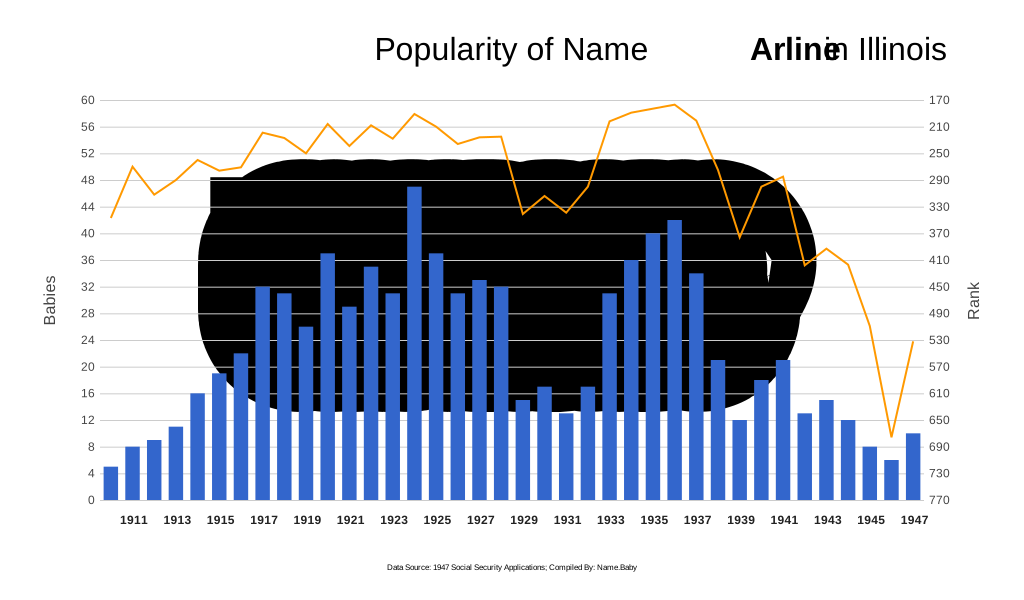
Arline is a feminine English-language name etymologically linked to the Germanic root arn- “eagle” combined with the diminutive suffix -lind and, by extension, regarded as a variant of Arlene, itself a 20th-century elaboration on the French Arlette. It is uniformly articulated as AR-leen (IPA: /ˈɑː.lin/ in British English; /ˈɑr.lin/ in American English), exhibiting an identical phonemic profile across major Anglo-American dialects. Morphologically, the name’s disyllabic structure—comprising the onset AR- and the coda -line—yields a closed–open syllable pattern that facilitates its transcription in both Received Pronunciation and General American. Analysis of Illinois birth-registration data from 1910 through 1947 reveals that Arline attained its peak popularity in 1910, when five recorded occurrences secured it the 103rd rank, before entering a period of gradual decline: by the mid-1940s it fluctuated between ranks in the mid-150s to high-180s, and by 1947 it stood at 203. Situated within the corpus of Anglo-American anthroponymy, Arline remains of technical interest for its precise morphological composition and its discrete diachronic usage trajectory.
Pronunciation
British English
- Pronunced as AR-leen (/ˈɑː.lin/)
American English
- Pronunced as AR-leen (/ˈɑr.lin/)
U.S. Popularity Chart
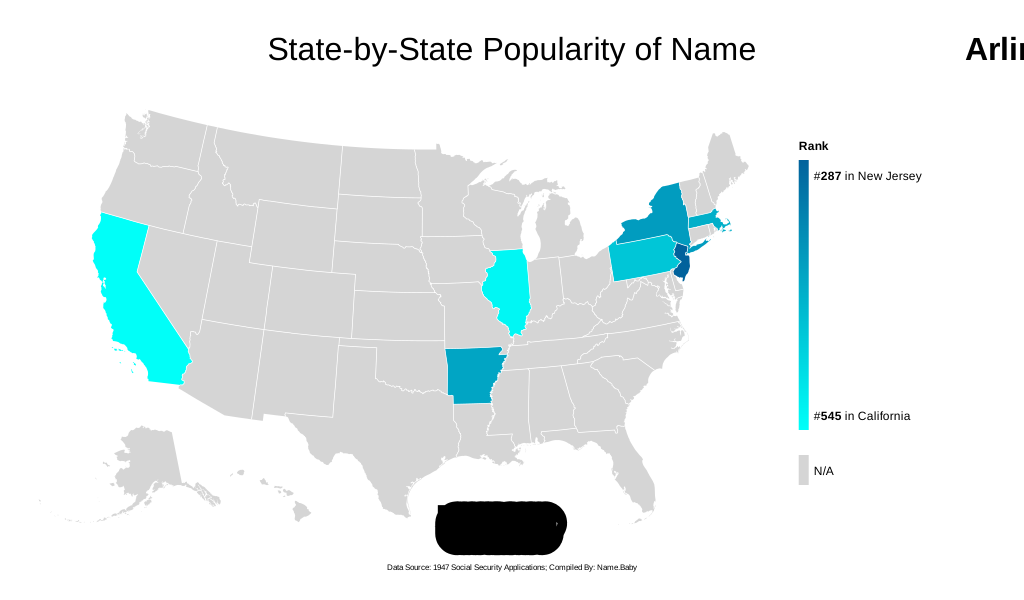
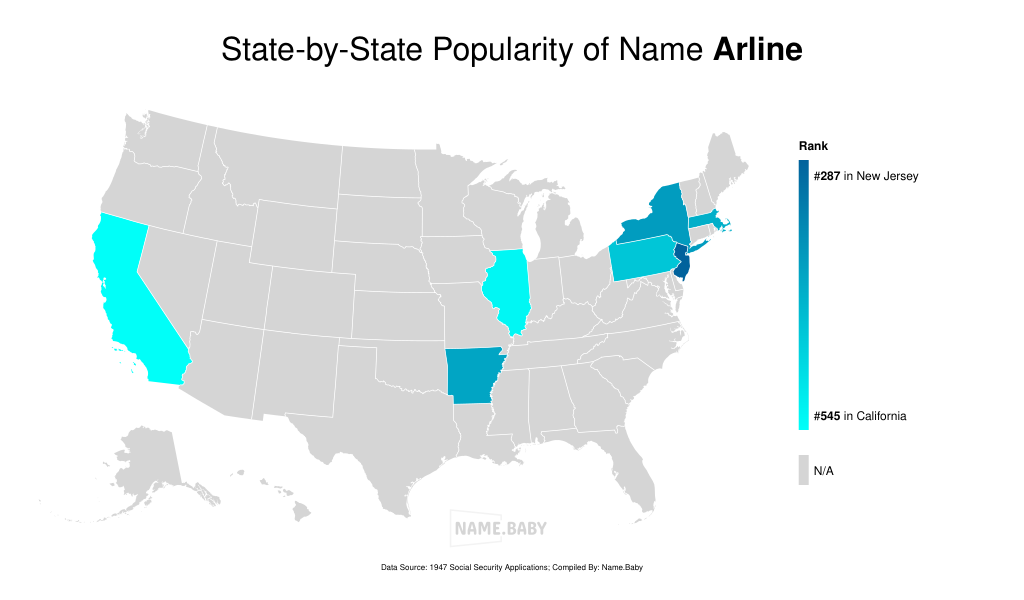
States Popularity Chart
Notable People Named Arline
| Arline Fisch was an American artist and educator who pioneered using textile techniques like knitting and weaving to create metal jewelry. |
| Arline Hunter was an American actress and model best known as Playboy's Playmate of the Month for August 1954. |
| Arline Geronimus is an American public health researcher known for her pioneering work on how racism and chronic stress affect health. |
| Arline Garson was an American film and television editor known for her work on The Beatles at Shea Stadium and A Nightmare on Elm Street 2. |
