Duke
Meaning of Duke
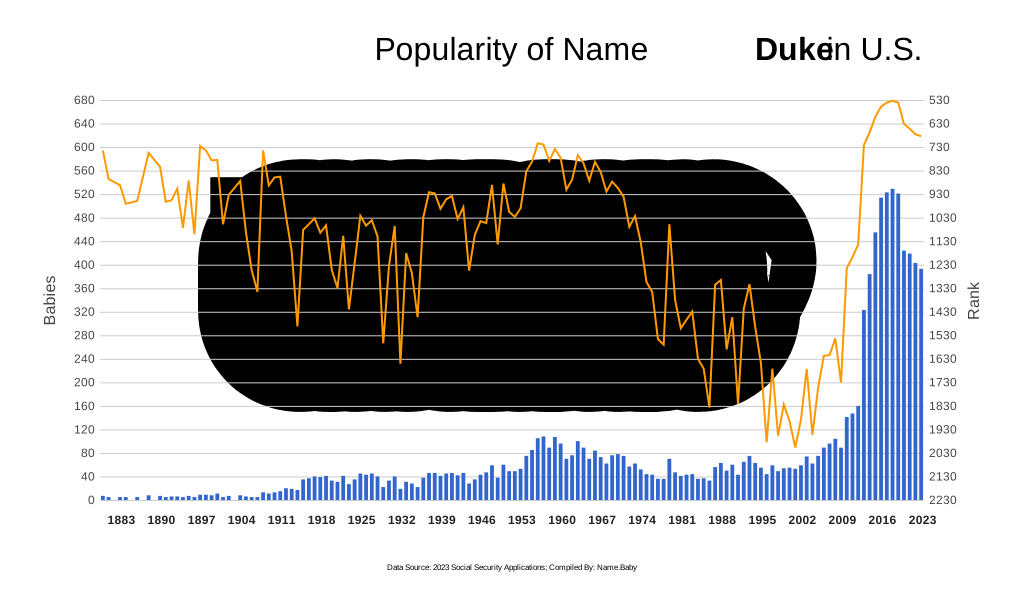
Deriving from the Latin dux, “leader,” and entering Middle English as the highest non-royal title in the peerage, Duke migrated into given-name territory only after centuries of aristocratic and military association, thereby retaining a connotation of command and hereditary dignity even in its most contemporary usages. In the United States, the appellation owes much of its cultural imprint to twentieth-century figures—most notably the jazz composer Duke Ellington and the screen persona of John Wayne—whose public visibility translated the title into a personal moniker with distinctly American resonance; the continued prominence of Duke University further reinforces this linkage between the name and notions of excellence and prestige. While the Social Security records show that Duke has never dominated the popularity tables, its uninterrupted presence since 1880 and its gradual climb into the mid-500s during the past decade testify to a sustained, if measured, appeal. For parents seeking a succinct, phonetically decisive name that signals authority without ostentation, Duke presents a historically weighty yet modernly accessible choice.
Pronunciation
British English
- Pronunced as DOOK (/djuːk/)
American English
- Pronunced as DOOK (/duːk/)
U.S. Popularity Chart
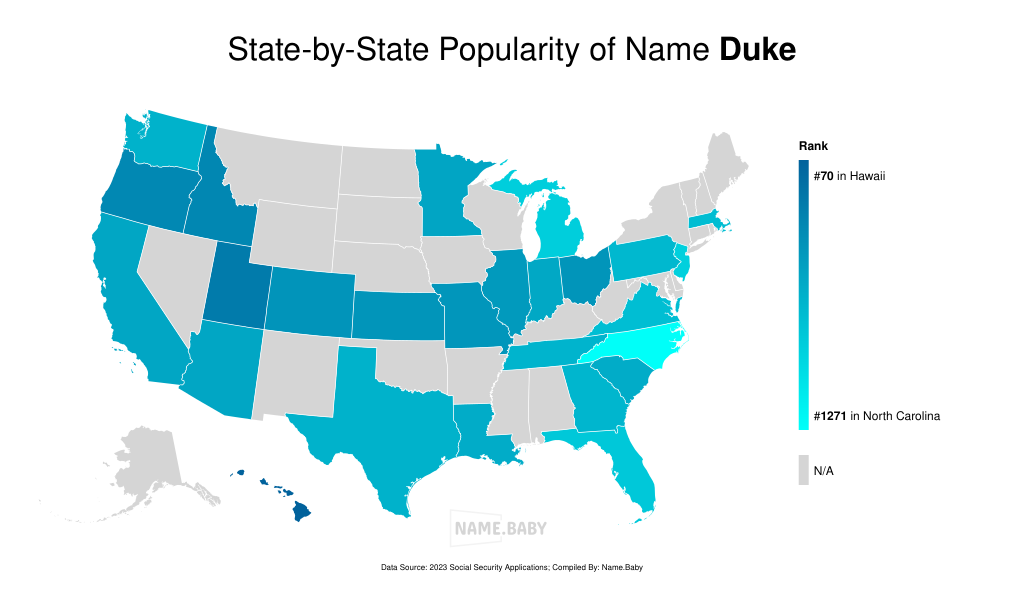
States Popularity Chart
Notable People Named Duke
| Duke Ellington - Edward Kennedy "Duke" Ellington was a legendary American jazz pianist, composer, and bandleader who led his orchestra from 1924 until his death. |
| Duke Kahanamoku was a Native Hawaiian Olympic swimmer who won five medals and helped popularize surfing worldwide. |
| Duke Pearson was an American jazz pianist and composer who played a major role in shaping the Blue Note label's hard bop direction in the 1960s as a record producer. |
