Elmira
Meaning of Elmira
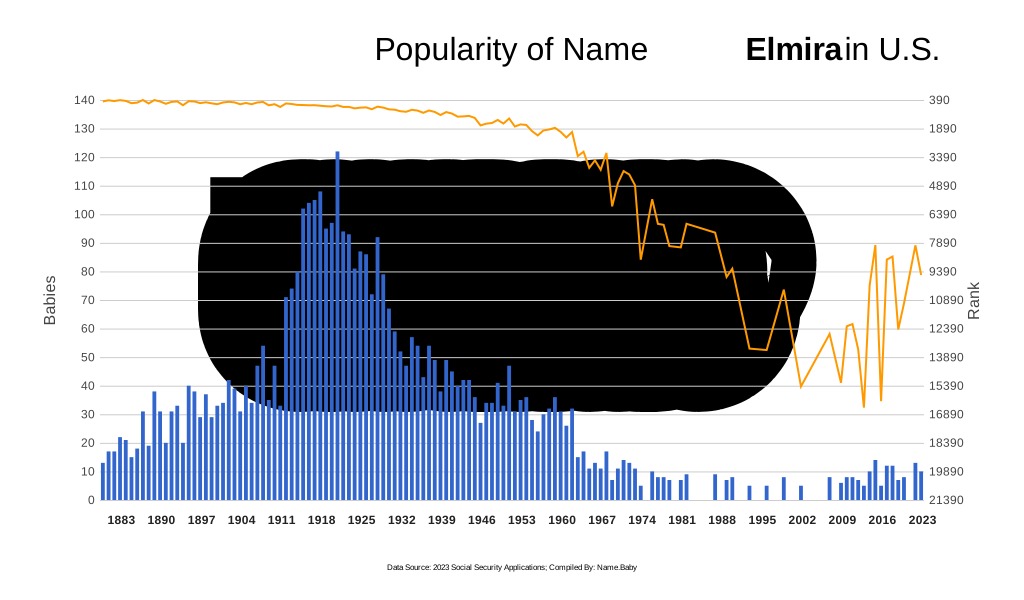
Elmira, a distinctly feminine appellation enunciated in English as /ˈɛl.maɪ.rə/, constitutes an intriguing juncture between medieval Latin adaptation and the Arabic amīra – signifying both ‘princess’ and ‘commander’ – a connotation that migrated across the Iberian Peninsula into Italy and crystallized in the dialogues of eighteenth-century teatro veneziano. Its sonorous cadence, at once regal and melodious, conjures a melodic echo of bygone courts while retaining the nuanced warmth characteristic of Romance tongues. An analytical examination of U.S. Social Security data reveals Elmira’s volatility in frequency over more than a century: initial prominence in the early 1920s (circa rank 489), sustained mid-century presence, a subsequent decline through the late twentieth century, and a modest twenty-first-century revival culminating in a ranking of 936 with 14 recorded births in 2024. Such patterns underscore the name’s capacity to traverse epochs and geographies, offering an enduring, if quietly sophisticated, option for parents drawn to names with historic depth and cross-cultural resonance.
Pronunciation
English
- Pronunced as el-MY-ruh (/ˈɛl.maɪ.rə/)
U.S. Popularity Chart
Notable People Named Elmira
| Elmira Minita Gordon was Belize's first governor general and the first Belizean to earn a doctorate in psychology. |
| Elmira Ramazanova was an Azerbaijani geologist, petroleum engineer and professor who worked to improve oil and gas extraction. |
| Elmira Mangum is an American educator who became the first woman to serve as permanent president of Florida A and M University. |
| Elmira Sergeyevna Zherzdeva was a Soviet and Russian singer honored as a Meritorious Artist. |
| Elmira Karapetyan is an Armenian sports shooter who competed in the women's 10 metre air pistol event at the 2020 Olympics. |
