Emil
Meaning of Emil
Emil, an Anglicised adaptation of the Roman family name Aemilius, derives from the Latin aemulus—“rival” in the sense of one who strives for excellence—and has migrated across Europe’s linguistic landscape with notable tenacity: transmitted through medieval ecclesiastical records, embraced by German and Scandinavian speakers, and ultimately borne to North America by nineteenth-century immigrants. Historical bearers such as the path-breaking German chemist Emil Fischer and the psychiatrist Emil Kraepelin, together with the enduring pedagogical influence of Jean-Jacques Rousseau’s treatise “Émile,” have intertwined the name with a quiet aura of intellectual rigor. In the United States, Social Security data disclose a pattern of modest yet consistent usage stretching from the late Victorian era to the present, reflecting a preference for brevity and continental sophistication rather than the ebb and flow of naming fashions. Consequently, Emil offers contemporary parents a succinct, pan-European alternative to cognates like Emilio or the feminine Emilia—refined, unpretentious, and freighted with a legacy of disciplined curiosity.
Pronunciation
German
- Pronunced as ay-meel (/aɪˈmi:l/)
English
- Pronunced as ee-mil (/i:ˌmɪl/)
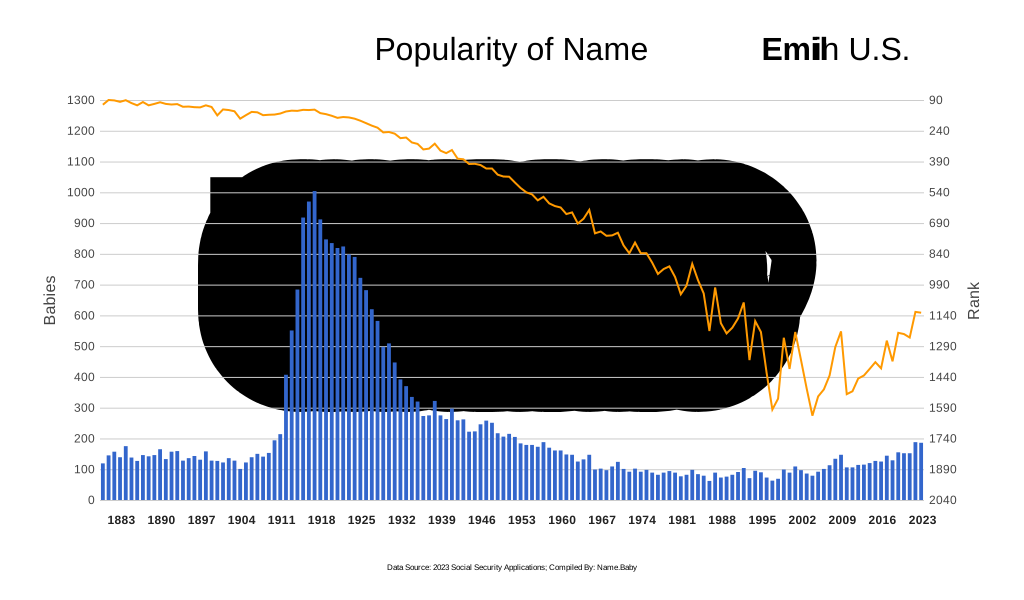
U.S. Popularity Chart
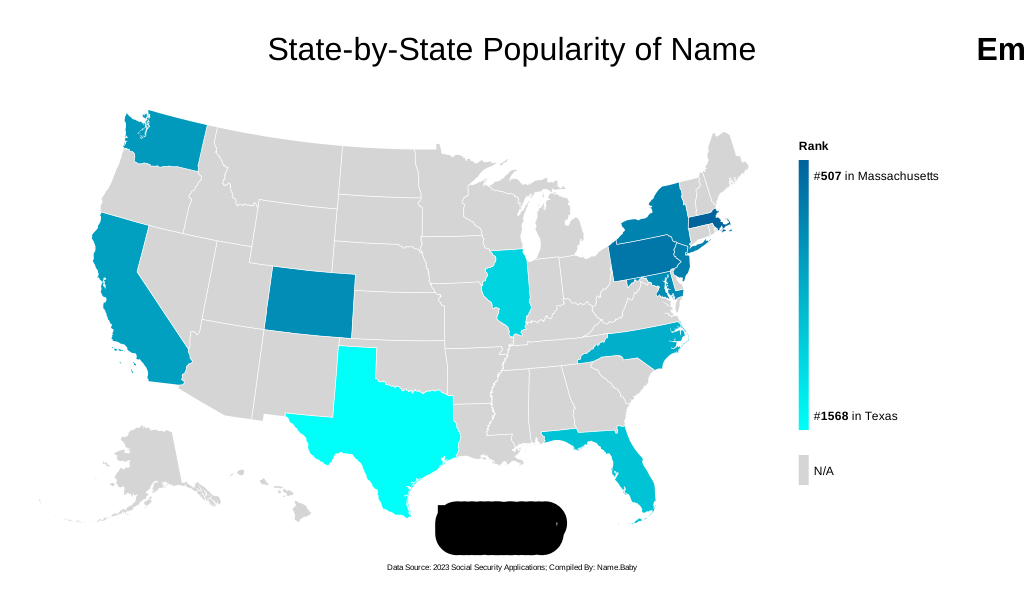
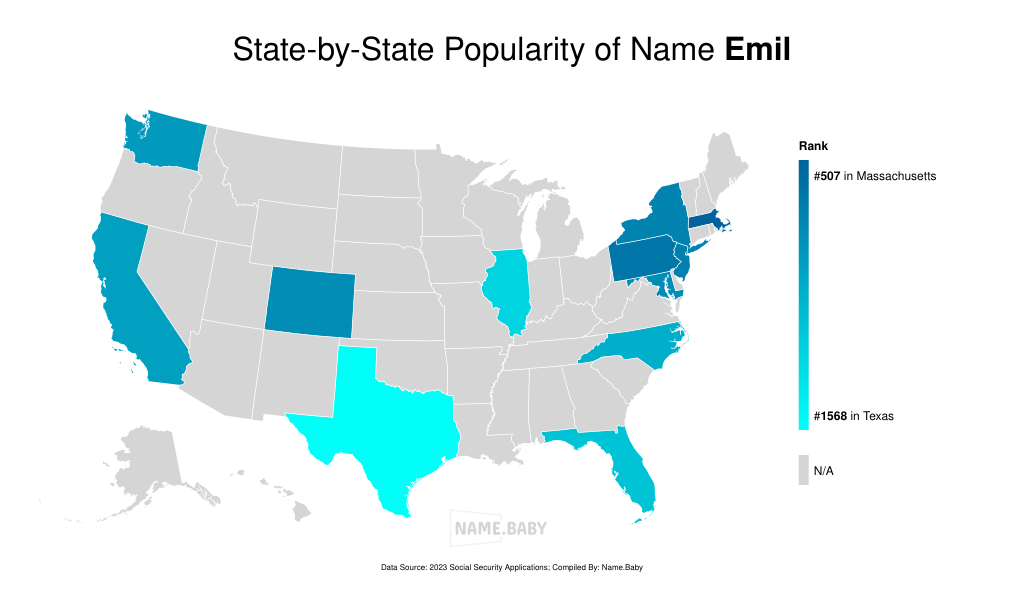
States Popularity Chart
Notable People Named Emil
| Emil Artin was an Austrian mathematician of Armenian heritage. |
| Emil Theodor Kocher was a Swiss surgeon who won the 1909 Nobel Prize in Physiology or Medicine for his pioneering thyroid research and for making surgery dramatically safer. |
| Emil Zátopek - Emil Zatopek was a Czech runner nicknamed the Czech Locomotive who won three gold medals at the 1952 Olympics. |
| Emil Gilels was a Russian and Soviet musician widely regarded as one of the greatest pianists of all time. |
| Emil Warmiński - Emil Warminski was a Polish physician and activist who founded the Polish House in Bydgoszcz. |
| Emil von Behring was a German physiologist who won the very first Nobel Prize in Physiology or Medicine in 1901 for developing a serum therapy against diphtheria, earning him fame as the saviour of children. |
| Emil Fuchs was an Austrian-born American sculptor and painter whose portraits of Queen Victoria and Edward VII made him a favorite of London high society. |
| Emil Grosswald was a mathematician celebrated for his work in number theory. |
| Emil Ludwig was a German-Swiss writer best known for his biographies of history's great figures. |
| Emil Hegle Svendsen is a retired Norwegian biathlete who won nine Olympic medals and twelve World Championship gold medals. |
| Emil Hațieganu was a Romanian jurist and politician, a leading figure in the Romanian National Party and later the National Peasants' Party, and brother of the physician Iuliu. |
