Flavia
Meaning of Flavia
Flavia is a distinguished feminine name of Latin provenance, emerging from the ancient cognomen Flavius—itself rooted in the adjective flavus, “golden” or “blond”—and has long adorned members of the venerable Flavia gens in the annals of Rome. With a lineage that includes imperial figures and early Christian saints, the name weaves through history like a filament of sunlight glinting off marble columns, evoking both imperial gravitas and the warm glow of classical elegance. Its phonetic form in Italian, rendered FLAH-vee-uh (/ˈfla.vja/), carries the mellifluous cadence of sunlit piazzas and the lyrical resonance of Latin’s enduring legacy. In scholarly discourse, Flavia is often celebrated for its semantic richness—combining notions of luminosity, nobility, and fertile promise—and for its emblematic capacity to bridge antiquity and modernity. Worn today by those who cherish both historical depth and the promise of golden potential, the name Flavia stands as a testament to cultural continuity and the enduring allure of Rome’s linguistic heritage.
Pronunciation
Italian
- Pronunced as FLAH-vee-uh (/ˈfla.vja/)
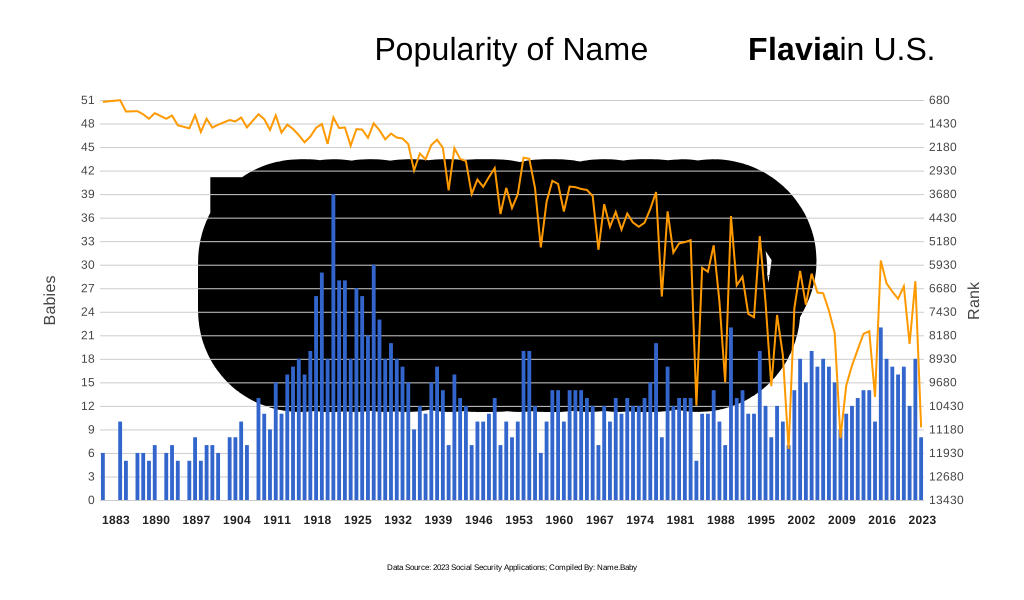
U.S. Popularity Chart
Notable People Named Flavia
| Flavia Pennetta is a retired Italian tennis champion who won the 2015 US Open singles title and reached world No. 1 in doubles. |
| Flavia Wasserfallen is a Swiss Social Democratic politician who has served on the Council of States since 2023. |
| Flavia Fortunato is an Italian singer, actress and television presenter known for her 1980s Italo disco music and Sanremo Music Festival appearances. |
| Flávia Renata Delaroli Cazziolato is a Brazilian freestyle swimmer who holds Olympic and National Records. |
