Franz
Meaning of Franz
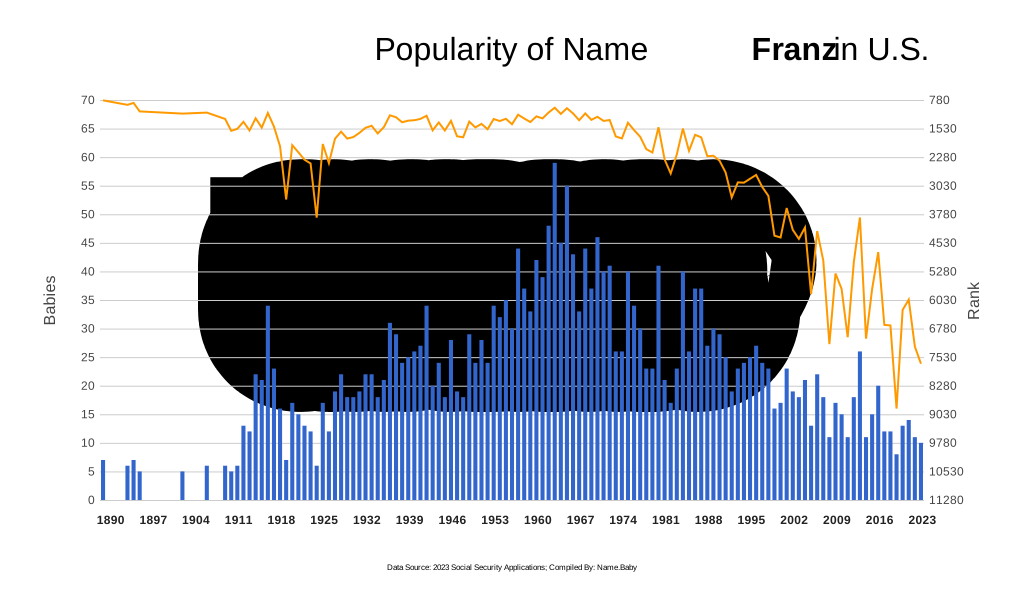
Franz, a masculine name of Germanic origin, derives from the Latin Franciscus—literally “Frenchman” or, by extension, “free one”—and has been integrated into German‐speaking cultures since the medieval period. Its concise phonetic profile, rendered in German as /fʁants/, conveys a sense of austere precision that appeals to parents seeking a designation both historically grounded and sonically distinct. Over the centuries, Franz has been borne by figures of considerable cultural import—from the melodic innovations of composer Franz Schubert to the existential narratives of writer Franz Kafka—thereby endowing the name with associations of artistic inquiry and intellectual depth. Although its popularity in the United States has remained modest, oscillating between the 700th and 900th ranks for male newborns over recent decades, the consistent presence of Franz attests to its enduring resonance within contemporary naming practices.
Pronunciation
German
- Pronunced as frants (/fʁants/)
U.S. Popularity Chart
Notable People Named Franz
| Franz Kafka was an influential Jewish writer from Prague, best known for The Metamorphosis and his surreal tales of isolation and bureaucracy. |
| Franz Liszt was a Hungarian composer and virtuoso pianist whose influential Romantic works remain widely performed today. |
| Franz Peter Schubert was a prolific Austrian composer known for his songs, symphonies, and piano works bridging the Classical and Romantic eras. |
| Franz Joseph I was Emperor of Austria and King of Hungary, reigning from 1848 until his death in 1916. |
| Franz Beckenbauer was a legendary German football player and manager who helped pioneer the modern sweeper role. |
| Franz Leopold Neumann was a German political scientist and labor lawyer best known for his analyses of Nazism. |
| Franz Paul Stangl was an Austrian police officer who commanded the Nazi extermination camps Sobibor and Treblinka during World War II. |
| Franz Marc was a German painter and printmaker who helped shape German Expressionism and co-founded Der Blaue Reiter. |
| Franz Viktor Werfel was a Czech novelist, playwright, and poet best known for The Forty Days of Musa Dagh and The Song of Bernadette. |
| Franz Lehár - Franz Lehar was an Austro-Hungarian composer best known for his operetta The Merry Widow. |
| Franz Oppenheimer was a German-American sociologist and political economist known for his work on the origins and nature of the state. |
