Garnet
Meaning of Garnet
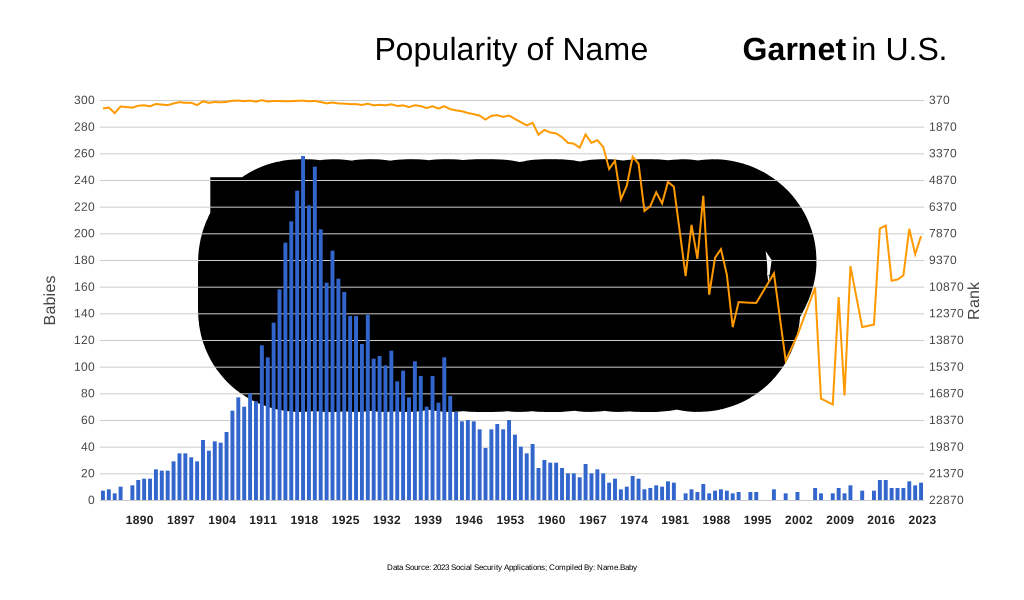
Derived from the Old French grenate and ultimately the Latin granatum, meaning “seed,” Garnet (pronounced GAHR-nit /ˈgɑr.nɛt/) carries the lustrous weight of its deep red gemstone namesake—long esteemed as an emblem of enduring love, constancy, and subtle power. In the early twentieth century, it enjoyed modest popularity—hovering within the top 400 names in the 1920s—before gradually receding into near obscurity; by 2024 it ranked 945th in the United States with just five newborns, a scarcity so pronounced that it feels more at home in a geological ledger than on a baby-naming registry. Yet this very rarity is its modern allure, offering a unisex choice that bridges vintage charm with contemporary audacity. Warm in its imagery yet precise in its etymology, Garnet appeals to those who appreciate a name that sparkles with historical resonance and analytical depth, revealing new facets of strength, devotion, and quiet confidence with every utterance.
Pronunciation
English
- Pronunced as GAHR-nit (/ˈgɑr.nɛt/)
U.S. Popularity Chart
Notable People Named Garnet
| Garnet Wolseley, 1st Viscount Wolseley - Garnet Wolseley was an influential Anglo-Irish general known for his military victories and efforts to modernize the British Army. |
| Garnet Burk Hughes was a Canadian major general who served in the First World War before moving to administrative roles. |
| Garnet Rogers is a Canadian folk singer, songwriter and composer born in Hamilton, Ontario, with Maritime roots. |
| Garnet Larae Anderson is an American biostatistician known for her research on the health risks of postmenopausal hormone therapy. |
| William Garnet Campbell was a Canadian curler and the first Saskatchewan skip to win the Brier. |
