Ginevra
Meaning of Ginevra
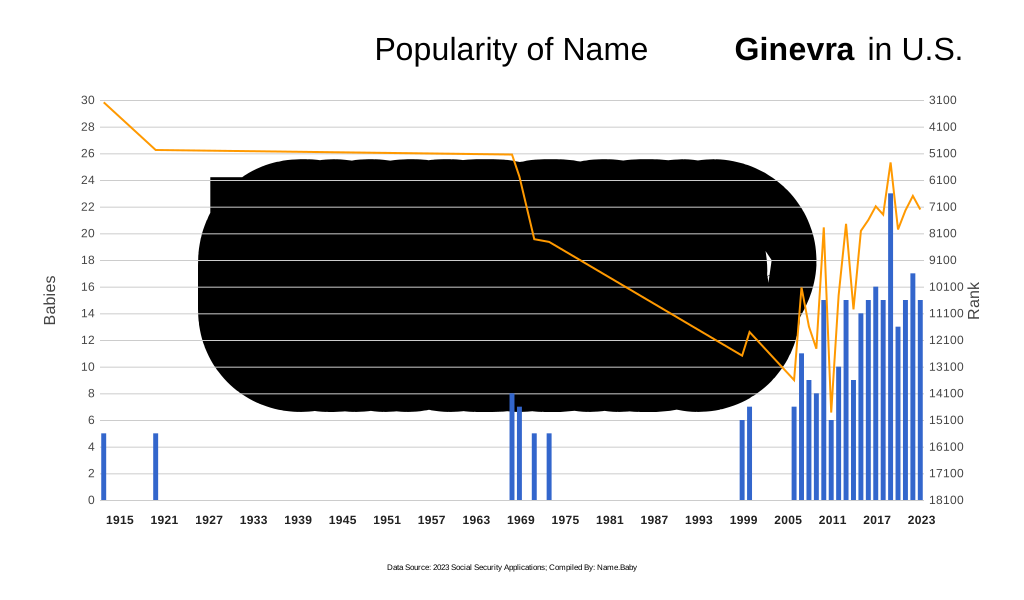
Ginevra is a feminine given name of Italian origin, the Tuscan form of Guinevere, which itself derives from the Welsh elements gwen (“white, fair”) and hwyfar (“smooth”), historically borne by the legendary Queen of Camelot. In Italian usage, pronounced jee-NEV-ruh (/dʒi.ˈnɛ.vra/), the name conveys an air of classical refinement and evokes Renaissance cultural heritage, a resonance further underscored by its association with Saint Ginevra of Milan, a fourth-century martyr, and the alpine city-state whose French appellation, Geneva, shares etymological roots. Although relatively rare in the Anglo-American sphere, Ginevra has shown a gradual uptick in the United States, ranking 925th in 2024 with twenty-five recorded instances, reflecting a discreet yet growing appreciation for its lyrical cadence and storied lineage. Employed chiefly in formal contexts, the name projects erudition and poised distinction, appealing to parents seeking a singular appellation with deep cultural resonance.
Pronunciation
Italian
- Pronunced as jee-NEV-ruh (/dʒi.ˈnɛ.vra/)
U.S. Popularity Chart
Notable People Named Ginevra
| Ginevra King Pirie was an American socialite and heiress whose romance with F. Scott Fitzgerald inspired Daisy Buchanan in The Great Gatsby. |
| Ginevra Elkann is an Italian film producer and director and the granddaughter of industrialist Gianni Agnelli. |
| Ginevra de Benci was a Florentine noblewoman known for her portrait by Leonardo da Vinci. |
