Giuseppe
Meaning of Giuseppe
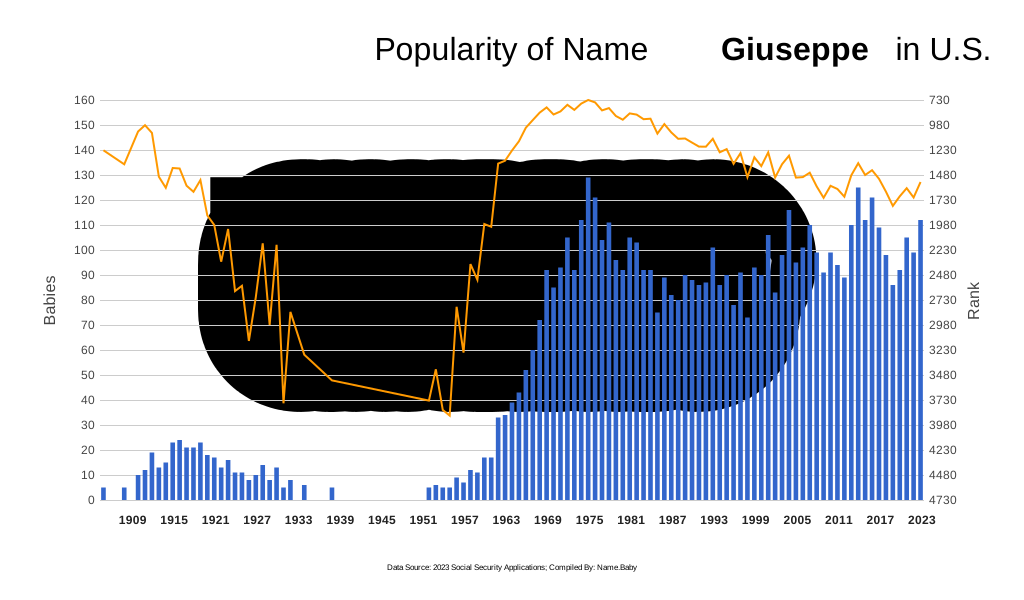
Giuseppe—rendered in Italian as dʒi-oo-ZEH-peh and commonly approximated in English as jee-oo-SEP-ee—constitutes the standard Italian form of the Hebrew-derived Joseph (“he will add”), and, while never numerous in the United States, it has maintained a remarkably steady, low-level presence that mirrors patterns of Italian immigration: since reliable records began in 1905, annual birth counts have hovered between five and a little over one hundred, with national ranks drifting in the mid-500s to mid-800s. The name’s cultural resonance extends well beyond its statistical footprint, evoking the quiet solidity of its biblical prototype, Saint Joseph, and the civic ideals embodied by figures such as Risorgimento patriot Giuseppe Garibaldi, operatic titan Giuseppe Verdi, and logician Giuseppe Peano. Together these associations confer an aura of disciplined creativity and steadfast responsibility, qualities that appeal to parents who seek a recognizably Italian yet internationally intelligible alternative to Joseph.
Pronunciation
Italian
- Pronunced as jee-oo-SEP-ee (/dʒiˈuːzeppe/)
U.S. Popularity Chart
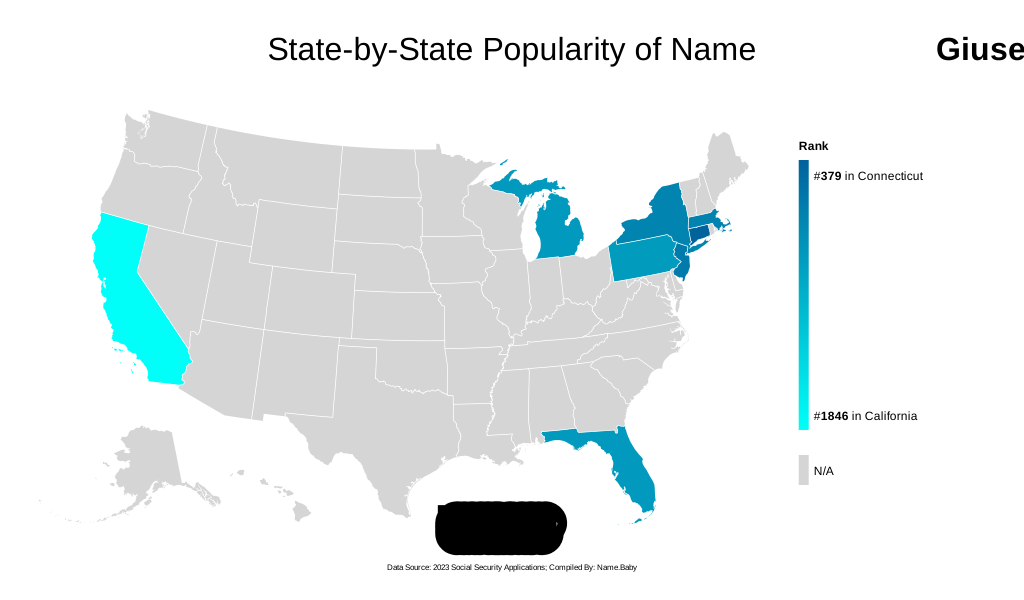
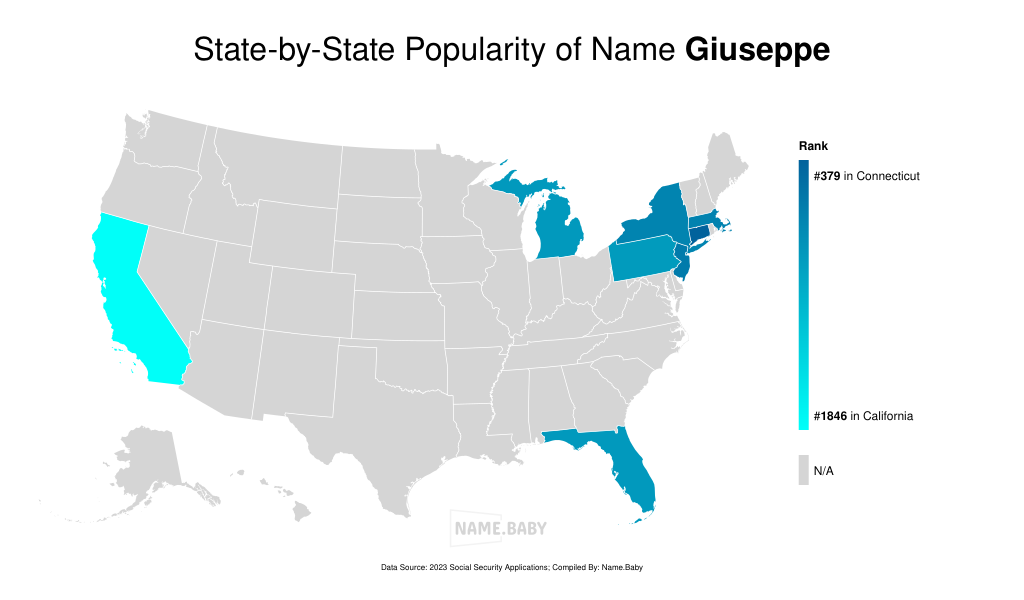
States Popularity Chart
Notable People Named Giuseppe
| Giuseppe Garibaldi was an Italian general and revolutionary who helped unify Italy and earned the nickname Hero of the Two Worlds for his battles in South America and Europe. |
| Giuseppe Mazzini was an Italian activist and philosopher whose revolutionary work helped unify Italy and earned him the title Prophet of Italian Nationalism. |
| Giuseppe Rossi is an American-born former forward who played for Italy and later served as Head of Soccer and Vice Chairman of the New York Cosmos. |
| Giuseppe Meazza was a legendary Italian striker who scored 284 goals for Inter Milan and led Italy to consecutive World Cup titles in 1934 and 1938. |
| Giuseppe Penone is an Italian sculptor celebrated for his large-scale tree sculptures that explore the bond between people and nature. |
| Giuseppe Arcimboldo was an Italian Mannerist painter famous for portraits of human heads made entirely of fruits and vegetables and other everyday objects. |
| Giuseppe Castiglione was an Italian Jesuit missionary who served as a court painter to three Qing emperors in China, blending European and Chinese artistic styles. |
| Giuseppe Ungaretti was a celebrated Italian modernist poet who began writing in the trenches of World War I and went on to win the first Neustadt International Prize for Literature in 1970. |
| Giuseppe Tartini was a prolific Italian violinist and composer of the Baroque era who is best remembered for his Violin Sonata in G Minor. |
| Giuseppe Peano was an Italian mathematician famous for the Peano axioms and for inventing Latino sine flexione, a simplified form of Latin. |
| Giuseppe Zanardelli was an Italian jurist and eloquent liberal statesman who served as Prime Minister from 1901 to 1903 and championed civil liberties, free trade and the right to divorce. |
| Giuseppe Moscati was an Italian doctor and biochemistry pioneer whose deep faith led the Catholic Church to declare him a saint in 1987. |
| Giuseppe Piazzi was an Italian priest and astronomer best known for discovering Ceres, the first dwarf planet. |
