Hedwig
Meaning of Hedwig
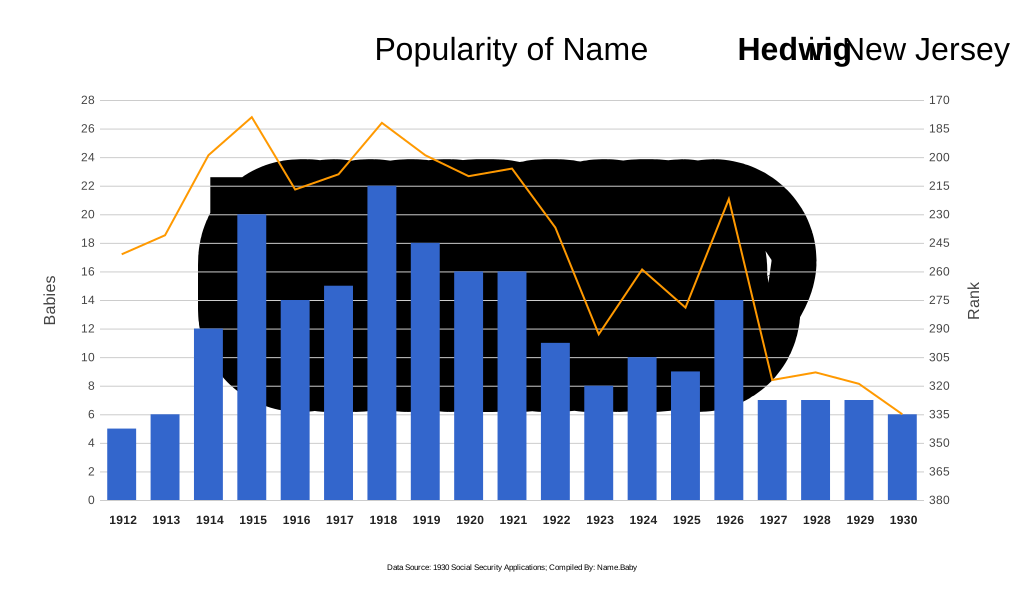
Hedwig, a feminine given name of Old High German origin, derives from the compound haidu (“battle, strife”) and wig (“combat”), thereby encoding a lexically explicit reference to martial fortitude. Historically, it adorned figures of ecclesiastical and noble distinction—most notably Saint Hedwig of Silesia—cementing its association with both piety and aristocratic lineage. Phonologically, the name manifests as HED-vik in German and adapts to HED-wig in contemporary English, a variation that evidences minor shifts in vowel articulation and terminal consonantal resonance while preserving its core morphemes. Examination of early twentieth-century New Jersey birth records reveals a modest but consistent usage—ranked between 97 and 140 from 1912 through 1930, with a zenith of eighteen occurrences in 1919—underscoring its discreet prevalence within Anglo-American naming patterns.
Pronunciation
German
- Pronunced as HED-vik (/ˈhɛt.vɪk/)
English
- Pronunced as HED-wig (/ˈhɛd.wɪɡ/)
U.S. Popularity Chart
Notable People Named Hedwig
| Hedwig Irene Gorski is an American poet and avant-garde artist credited with coining the term performance poetry. |
| Hedwig Jagiellon, Duchess of Bavaria - Hedwig Jagiellon was a Polish and Lithuanian princess who became Duchess of Bavaria through her marriage to Duke George. |
| Hedwig Kohn was a pioneering German physicist who fled Nazi persecution and continued her academic career in the United States. |
| Hedwig Hillengaß - Hedwig Hillengass was a German operatic soprano known for leading roles in operetta and opera, including notable premieres. |
| Hedwig Jagiellon, Electress of Brandenburg - Hedwig Jagiellon was a Polish and Lithuanian princess who became Electress of Brandenburg through her marriage to Joachim II Hector. |
| Hedwig Courths-Mahler was a German author known for her romance novels and several pen names. |
| Hedwig Röckelein - Hedwig Rockelein is a professor of medieval history at the University of Gottingen in Germany. |
| Hedwig of Masovia was a Polish princess from the Masovian branch of the Piast dynasty. |
