Llewelyn
Meaning of Llewelyn
In its native Welsh cradle, Llewelyn (thloo-EH-lin) unfurls like a banner of ancient leadership, its very syllables humming with the spirit of “lion-hearted” valor. Steeped in the lore of medieval princes—most famously Llywelyn ap Gruffudd, the last native ruler of Wales—this name carries a noble weight, as if carved from the granite ramparts of a mist-shrouded castle. Yet beneath its august heritage beats a warm, tender heart, inviting modern families to weave their own stories into its rich tapestry. With a flourish worthy of a Latin sonnet—fortis et fidelis, “strong and faithful”—Llewelyn blends Celtic soul and classical grace, promising a little leader whose roar is as gentle as a lullaby.
Pronunciation
Welsh
- Pronunced as thloo-EH-lin (/ɬɛˈwɛlɪn/)
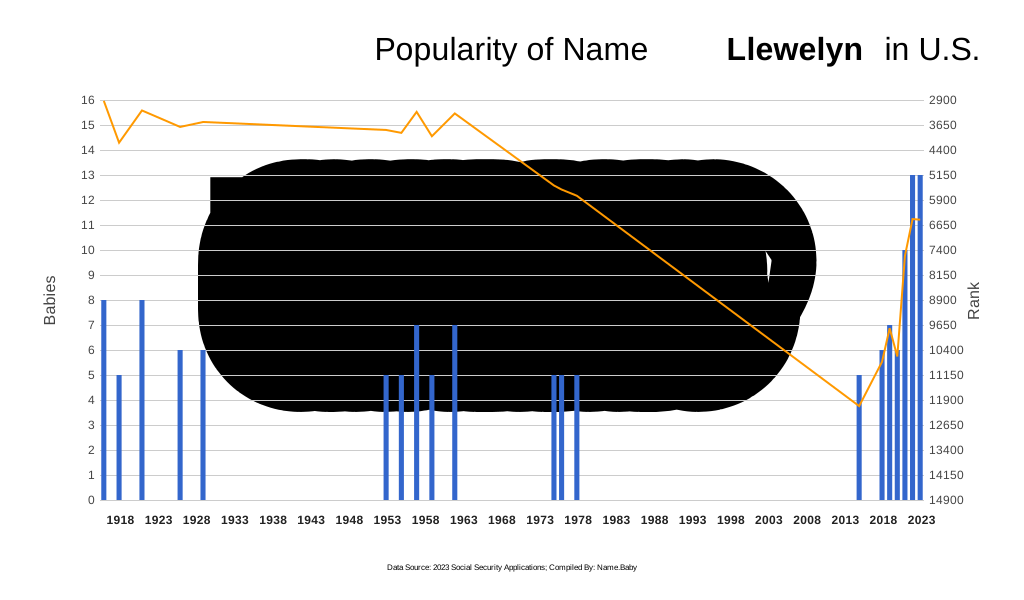
U.S. Popularity Chart
Similar Names to Llewelyn
Notable People Named Llewelyn
| Samuel Llewelyn Kenrick was a Welsh solicitor who founded the Football Association of Wales and became known as the father of Welsh football. |
| Llewelyn Powys was a British essayist and novelist, and the younger brother of writers John Cowper Powys and T. F. Powys. |
| Llewelyn Crichton Davies was a Welsh World War I flying ace credited with five aerial victories. |
| Llewelyn David Bevan was a Congregational minister and academic active in Australia, married to the notable Louise Jane Bevan. |
| Llewelyn Lloyd was a British-Italian painter associated with the Post-Macchiaioli movement. |
| Llewelyn Wyn Griffith was a Welsh novelist best known for Up to Mametz, a memoir of his World War I service. |
| Llewelyn Jones is a Welsh rugby player. |
