Maybelle
Meaning of Maybelle
Maybelle emerges as a lyrical compound, its first element—May—evoking the verdant resurgence of Maia, the Roman matron of spring, and its second—belle—drawing from the Latin adjective bellus, “beautiful,” to confer an almost sculptural grace upon the bearer’s identity. In its formal morphology, Maybelle exemplifies affixal synthesis, uniting a temporal marker of renewal with an aesthetic attribute, a union that resonates like a fresco painted at dawn: subtly vivid, yet suffused with classical poise. Academically, this name may be viewed as an exemplar of sound symbolism, in which the open-mid diphthong /eɪ/ suggests expansiveness while the bilabial closure of /b/ and the liquid /l/ lend it a gentle gravitas. Culturally, it carries the warm patina of Southern folklore and the refined lineage of Old French diminutives—an appellation at once intimate and dignified, recalling ancestral parlors redolent of magnolia blossoms and the genteel cadence of whispered familial blessings. Through its dryly elegant construction, Maybelle invites associations of perennial beauty, scholarly refinement, and the quiet assurance of spring’s renewal embedded in every syllable.
Pronunciation
British English
- Pronunced as MAY-bel (/meɪ-ˈbel/)
American English
- Pronunced as MAY-bel (/meɪ-ˈbɛl/)
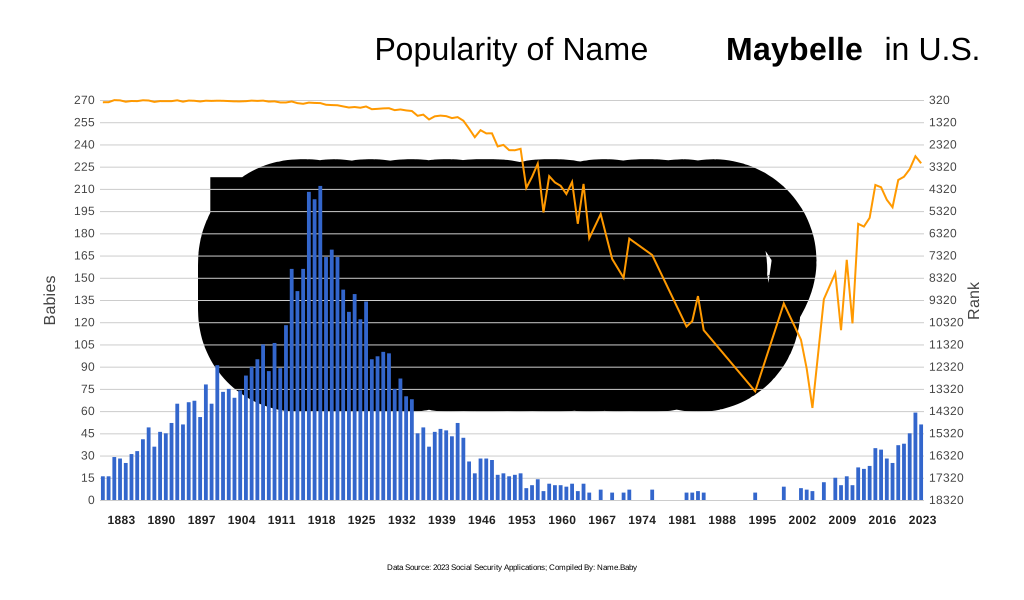
U.S. Popularity Chart
Notable People Named Maybelle
| Maybelle Carter was a pioneering American country musician whose signature Carter scratch guitar style helped make the guitar a lead instrument. |
| Maybelle Maud Park was a Wisconsin doctor who became the first director of the State Board of Control's child welfare department in 1922. |
| Maybelle Stephens Mitchell was an American activist who championed women's voting rights in Georgia and was the mother of author Margaret Mitchell. |
