Misa
Meaning of Misa
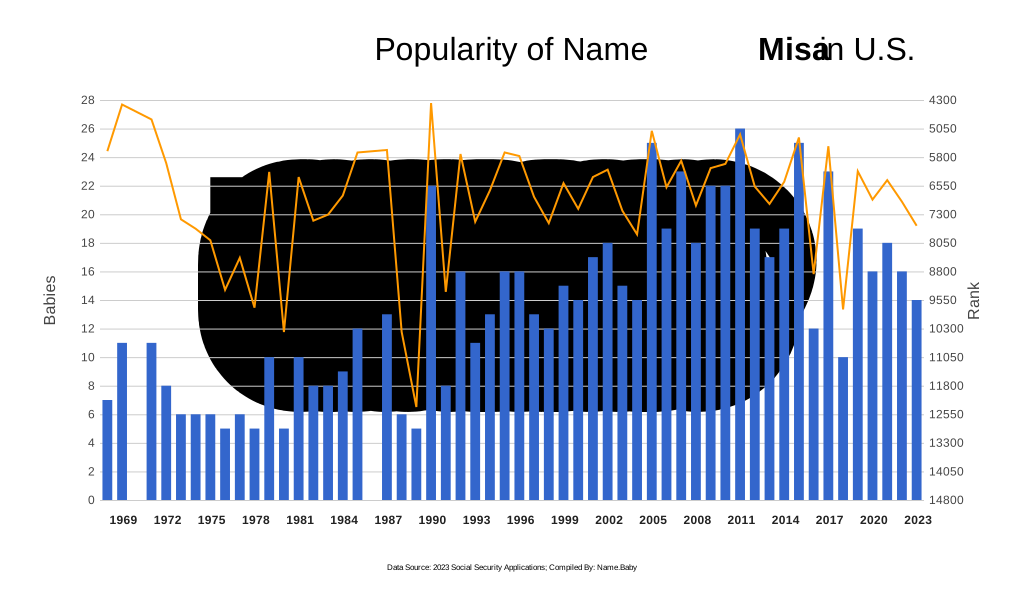
Misa is a feminine given name exhibiting multiple independent origins, particularly within Slavic and East Asian linguistic traditions. In Czech, where it is pronounced /miˌsa/, Misa often functions as a diminutive form of names such as Michaela or Miroslava, thereby conveying a sense of endearment rooted in regional naming practices. In Japanese, where it is pronounced /miˌsɑ/, the name derives from various kanji combinations—commonly incorporating 美 (“beauty”) alongside 沙 (“sand”) or 佐 (“assist”)—each configuration imparting a distinct semantic nuance. Empirical data from the United States Social Security Administration demonstrate that Misa’s annual frequency of registration has hovered in the single to low double digits since the late 1960s, yielding national popularity rankings primarily within the 700–950 range. This sustained, albeit modest, usage across several decades underscores the name’s cross-cultural versatility and its capacity to fulfill scholarly and parental interest in succinct appellations imbued with multiple semantic layers.
Pronunciation
Czech
- Pronunced as MEE-sah (/miˌsa/)
Japanese
- Pronunced as MEE-sah (/miˌsɑ/)
U.S. Popularity Chart
Notable People Named Misa
| Misa Yamamura was a Japanese novelist celebrated as the queen of mystery and often compared to Agatha Christie. |
| Misa Hylton is an American stylist and fashion designer known for shaping hip-hop fashion through her work with Lil Kim and Mary J. Blige. |
| Misa Shimizu is an award-winning Japanese actress known for her roles in The Eel and Sumo Do, Sumo Don't. |
| Misa Kuranaga is a Japanese ballerina and San Francisco Ballet principal who became Boston Ballet's first Asian principal dancer. |
| Misa Telefoni Retzlaff is a Samoan author and retired politician who served as deputy prime minister from 2001 to 2011. |
| Misa Amano is a Japanese swimmer who competed in the 2004 Olympics and set multiple national records in individual medley events. |
| Misa Matsushima is Japan's first female fighter pilot. |
| Misa Eguchi is a Japanese former professional tennis player. |
