Montague
Meaning of Montague
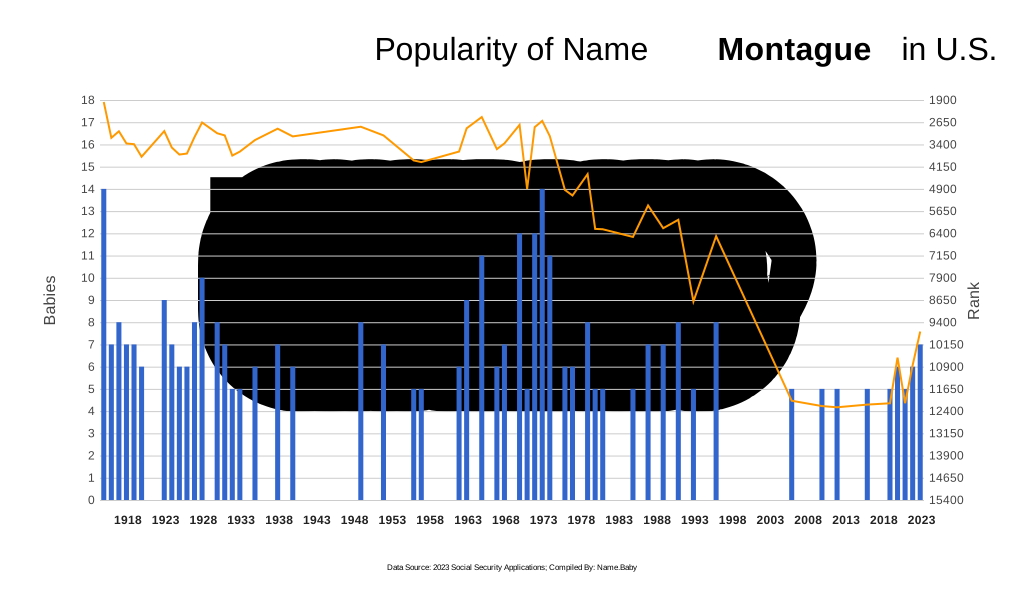
Montague, pronounced mon-TAYG (/mɒnˈteg/), originates as an Anglo-Norman surname derived from the Old French montagne, literally denoting “mountain” or “pointed hill,” and originally used to identify inhabitants of elevated terrain. Following the Norman Conquest, it entered English heraldic traditions as a marker of lineage and landholding, later acquiring lasting prominence in Shakespeare’s Romeo and Juliet as the name of Romeo’s family, where it conveys both aristocratic dignity and the gravitas of intergenerational allegiance. Adopted occasionally as a masculine given name in Anglo-American contexts, Montague has remained deliberately rare—hovering near the 900th rank in U.S. birth statistics in recent years—underscoring its appeal to parents who favour historical resonance, formal refinement and an understated sense of distinction.
Pronunciation
English
- Pronunced as mon-TAYG (/mɒnˈteg/)
U.S. Popularity Chart
Notable People Named Montague
| Montague John Druitt was an English barrister and educator suspected of being Jack the Ripper. |
| Montague Woodhouse, 5th Baron Terrington - Christopher Montague Woodhouse was a British intelligence officer and Conservative politician who served as MP for Oxford. |
| Montague Eliot, 8th Earl of St Germans - Montague Charles Eliot was a British peer, courtier and the 8th Earl of St Germans. |
| Montague Joseph Feilden was a British politician associated with the Liberal and Whig parties. |
| Montague Francis MacLean was an English first-class cricketer. |
