Nandini
Meaning of Nandini
The name Nandini is a feminine appellation of Sanskrit derivation, originating from the root √nand- (“to rejoice”) and conventionally rendered as “she who bestows joy” or “the delight-bringer.” In classical Hindu texts and iconography, it serves as an epithet of the goddess Parvati, underscoring attributes of nurturing compassion and creative fecundity. Phonologically, it is articulated in Indian English as nahn-DEE-nee (/nɑnˈdiːni/), exhibiting a trochaic stress pattern and a three-syllable structure that affords both clarity and rhythmic balance. From an onomastic standpoint in the United States, Nandini has maintained a modest but stable presence: in 2024, fifteen newborns received the name (rank 935), while its highest recorded incidence in the past forty years occurred in 2006 with fifty-six registrations (rank 911). Such longitudinal stability within the 800–950 rank band reflects a niche yet enduring embrace of Nandini within Anglo-American naming conventions, driven by its semantic depth, cultural resonance, and phonetic precision.
Pronunciation
Indian
- Pronunced as nahn-DEE-nee (/nɑnˈdiːni/)
U.S. Popularity Chart

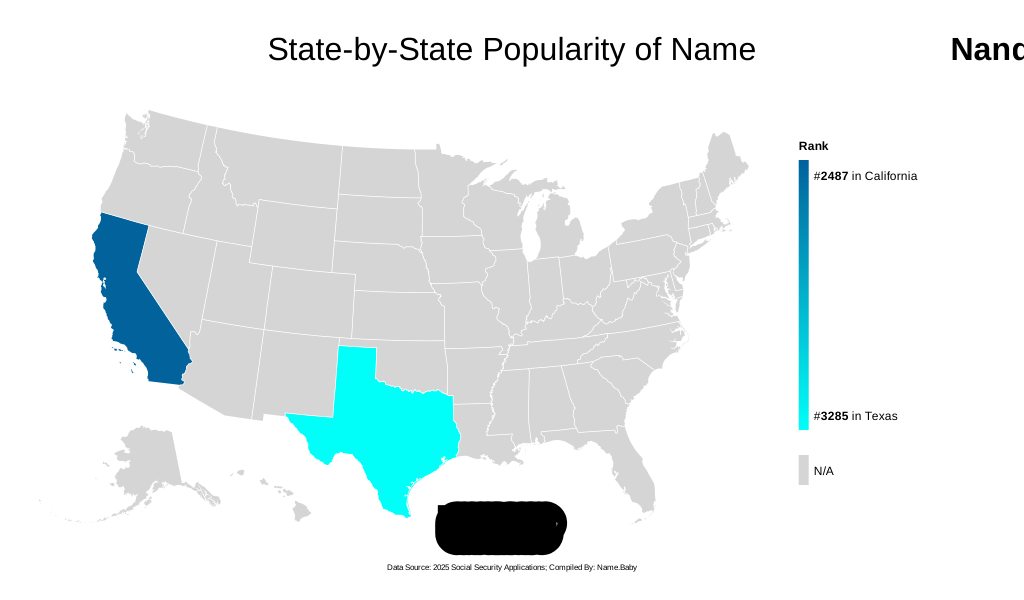
States Popularity Chart



Notable People Named Nandini
| Nandini Satpathy was an Indian politician and author who served as Chief Minister of Odisha from 1972 to 1976. |
| Dr Nandini Mundkur is an Indian developmental paediatrician known for pioneering early detection and intervention for developmental disorders. |
| Nandini Kannan leads the Indo US Science and Technology Forum and serves as Dean of Academics and Director of the Data Science Institute at Plaksha University. |
| Nandini Singh is an Indian actress best known for her roles in the television dramas Kesar and Kkavyanjali. |
| Nandini Harinath is an ISRO scientist who helped plan and operate India's Mars Orbiter Mission, Mangalyaan. |
| Nandini Devi is an Indian politician who represented Sanakhemundi in the Odisha Legislative Assembly after winning the 2014 election. |
