Nannie
Meaning of Nannie
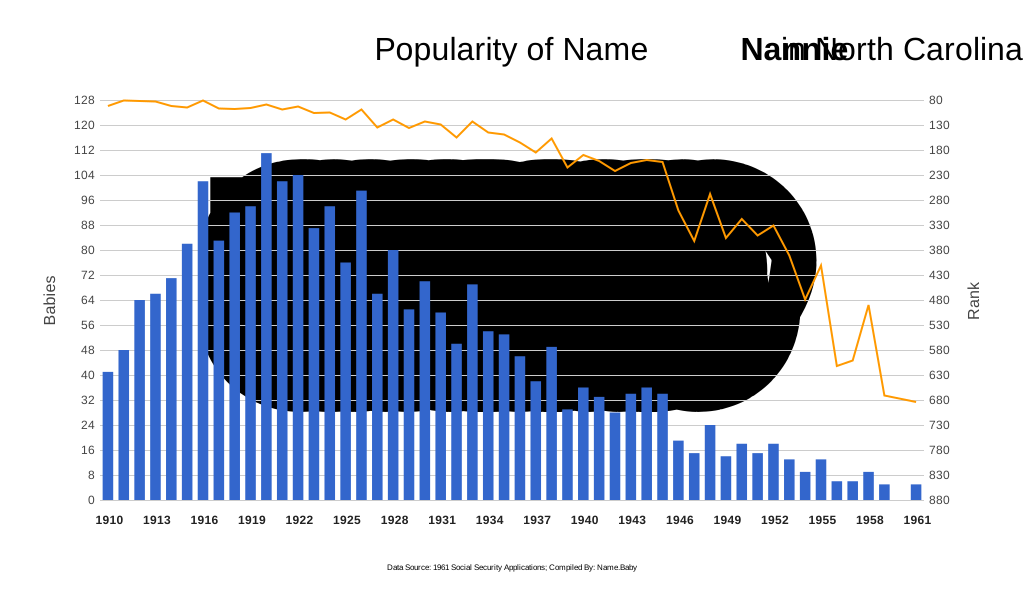
Nannie, pronounced NAN-ee (/ˈnæni/), emerges as an affectionate diminutive of Anna or Anne—names rooted in the Hebrew Channah (“grace”) and cemented through the Roman Annia gens—imbuing it with a subtly classical, Latin-inflected pedigree. An analysis of North Carolina birth records from 1910 to 1961 reveals its nuanced rise and fall: first appearing in 1910 at rank 67 with 41 occurrences, climbing briefly into the top 60 during the early 1910s, then oscillating between ranks 100 and 130 through the 1930s and 1940s, before tapering off to just five newborns at rank 173 by 1961. This trajectory mirrors broader sociolinguistic shifts from diminutive intimacy toward more formalized appellations, yet Nannie retains an enduring resonance—much like the gentle refrain of a “nana” lullaby in Latin-derived tongues—bridging familial warmth and historical gravitas with every utterance.
Pronunciation
English
- Pronunced as NAN-ee (/ˈnæni/)
U.S. Popularity Chart
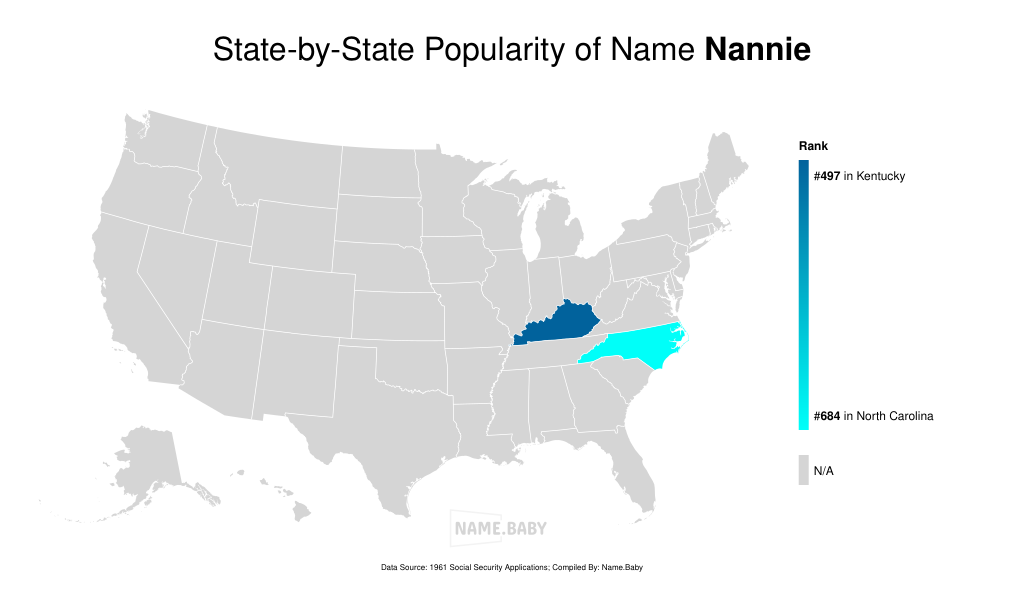
States Popularity Chart
Notable People Named Nannie
| Nannie Helen Burroughs was an American educator and civil rights activist who founded a school to empower Black women and girls. |
| Nannie Doss was an American serial killer known as the Giggling Granny, responsible for 11 deaths between 1927 and 1954. |
| Nannie Florence Dryhurst was an Irish writer, translator, and activist known for her nationalist beliefs. |
| Nannie Kelly Wright, born Nannie Scott Honshell, was the only known female ironmaster in America. |
| Nannie Louise Wright was an American composer, pianist, and music educator who led music programs in her hometown of Fayette, Missouri. |
