Pixie
Meaning of Pixie
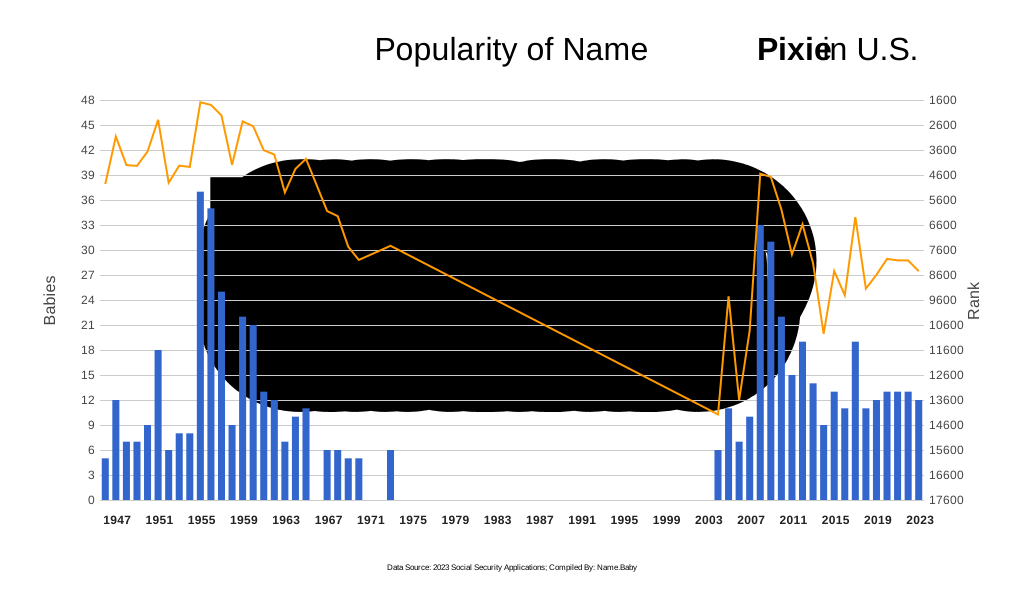
Pixie is a feminine given name of English origin, etymologically grounded in the folkloric term pixie, denoting a diminutive supernatural being in southwestern English and Cornish tradition. Phonetically represented as /ˈpɪk.si/, the name exhibits a trochaic, disyllabic structure that contributes to its succinct, percussive character. First attested in personal naming contexts during the mid-20th century—its earliest sustained appearance in United States Social Security records dating to the 1940s—the appellation achieved peak frequency in the mid-1950s before receding into sporadic use; by 2024, seven recorded births placed Pixie at rank 943 nationally, underscoring its continued but niche adoption. Analytical consideration of its socio-cultural resonance reveals dual connotations: on one hand, a whimsical allusion to agility and mischief derived from mythic lore; on the other, a modern association with avant-garde fashion—most notably the “Pixie” haircut—reflecting an undercurrent of nonconformity. In both British and American naming practices, Pixie remains a technically precise, stylistically unconventional choice, appealing to parents seeking a lexically distinctive and historically layered personal name.
Pronunciation
English
- Pronunced as PIK-see (/ˈpɪk.si/)
U.S. Popularity Chart
Notable People Named Pixie
| Pixie Lott is an English singer, songwriter, and actress known for her debut album Turn It Up and chart-topping hits Mama Do and Boys and Girls. |
| Pixie O'Harris was a Welsh-born Australian artist and author known for her children's book illustrations and enchanting hospital murals. |
| Pixie Love Davies is a British actress best known for playing Annabel Banks in Mary Poppins Returns. |
| Pixie Geldof is an English model and singer, and the third daughter of Bob Geldof and Paula Yates. |
| Pixie Williams was a New Zealand singer best known for her 1949 recording of Blue Smoke and inducted into the New Zealand Music Hall of Fame in 2019. |
