Renan
Meaning of Renan
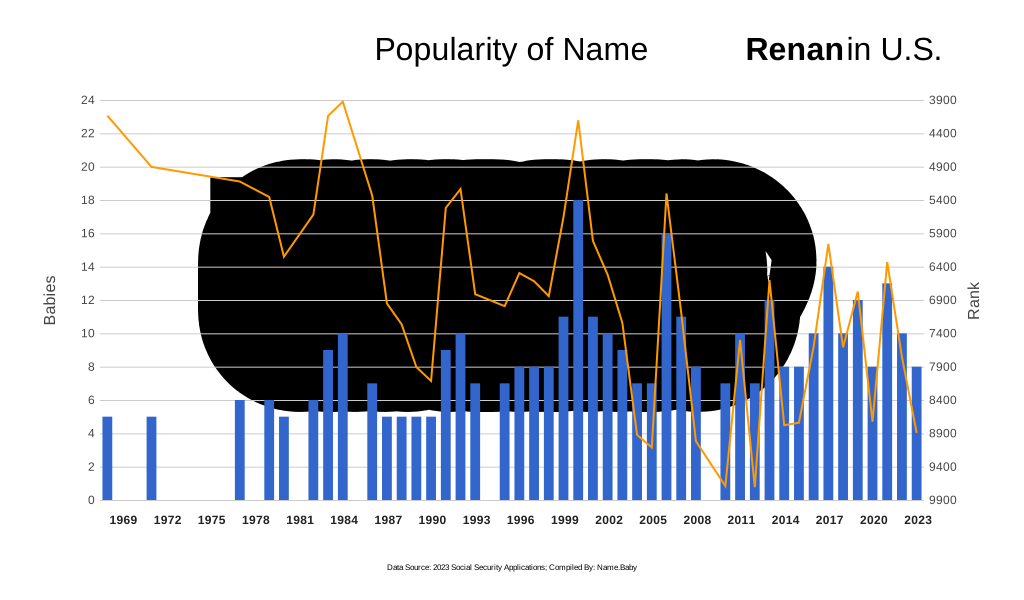
Renan is a masculine given name of Hebrew provenance, derived from the triconsonantal root r-n-n signifying “to rejoice” or “song of joy,” and thus bearing a precise semantic nuance of exultation; its phonetic rendering in English—uniform across American and British varieties—is /rəˈnæn/, featuring a reduced initial schwa and a stressed nasal syllable. Examination of United States Social Security data reveals that Renan has occupied a low-frequency yet consistent position in the national onomastic landscape since the late twentieth century, with annual birth registrations oscillating between five and eighteen and corresponding rankings fluctuating roughly from the mid-600s to the low-900s; in 2024, ten newborns were named Renan, placing it at 914th. Beyond North America, the name enjoys particular traction in Lusophone and Hispanophone contexts—exemplified by figures such as Brazilian footballer Renan Lodi—and sometimes draws inspiration from the legacy of intellectuals like the nineteenth-century French philologist Ernest Renan. Its enduring appeal lies in the confluence of a concise yet resonant phonological profile, a clear etymological foundation, and understated cross-cultural versatility.
Pronunciation
English
- Pronunced as reh-NAN (/rəˈnæn/)
U.S. Popularity Chart
Notable People Named Renan
| Renan Barão - Renan Barao is a Brazilian mixed martial artist and former UFC Bantamweight Champion known for his nine-year unbeaten streak. |
| Renan Bardini Bressan is a Brazilian-born former attacking midfielder who represented the Belarus national football team. |
| Renan Dal Zotto is a Brazilian former volleyball player, three-time Olympian and former head coach of Brazil's men's national team. |
| Jose Renan Calheiros Filho is a Brazilian economist and politician who served as governor of Alagoas from 2015 to 2022. |
| Renan Oliveira is a Brazilian footballer who plays as an attacking midfielder for Remo. |
