Suzanna
Meaning of Suzanna
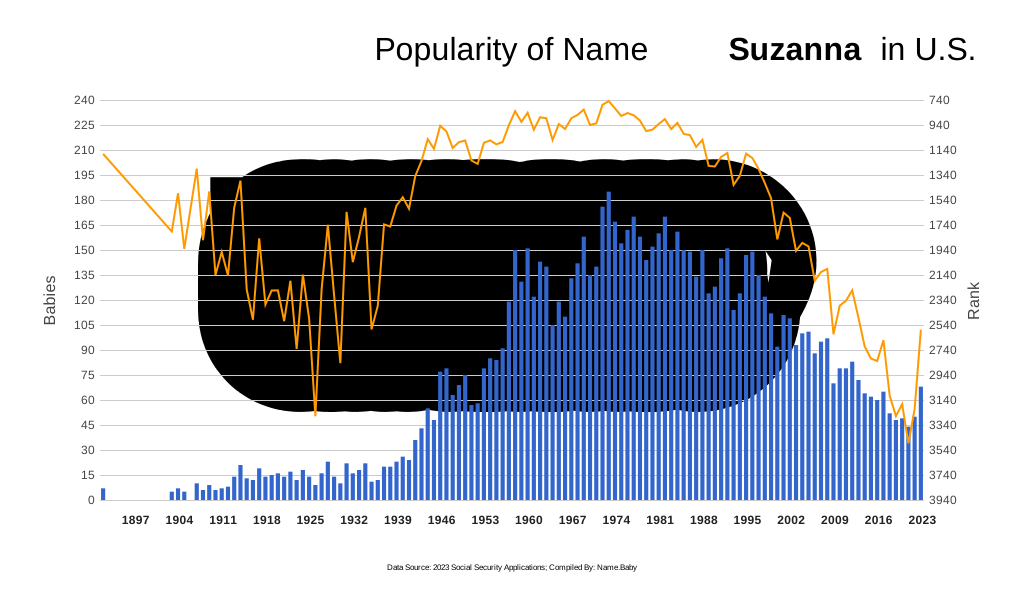
Suzanna, the two-n Anglicization of Hebrew Shoshannah—“lily”—entered English via Greek Sousánna and Latin Susanna and today is typically articulated /suˈzænə/, a crisp trisyllabic form whose consonant-vowel symmetry promotes effortless recognition. The name’s semantic association with the lily confers traditional symbolism of purity and renewal, while its cultural profile is reinforced by the deuterocanonical heroine in the Book of Daniel, Mozart’s witty chambermaid in The Marriage of Figaro, and a string of Anglo-American musical references that keep the spelling visually and aurally familiar. United States vital-statistics data trace a long arc of modest but uninterrupted usage, culminating in a post-war high of 176 registrations in 1972 before tapering to 59 in 2024, a pattern that positions Suzanna as statistically uncommon yet consistently present. The result is a designation that affords parents historical depth without overexposure, maintains cross-linguistic phonological clarity, and carries a quiet botanical elegance suited to academic, professional, and artistic milieus alike.
Pronunciation
American English
- Pronunced as soo-ZAN-uh (/suˈzænə/)
British English
- Pronunced as soo-ZAN-uh (/suˈzanə/)
U.S. Popularity Chart
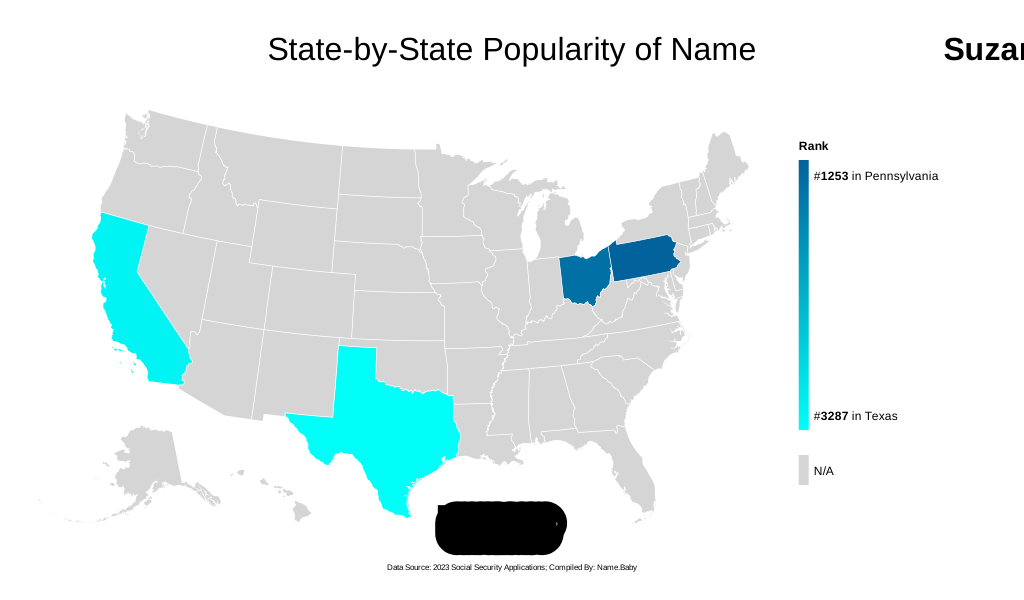
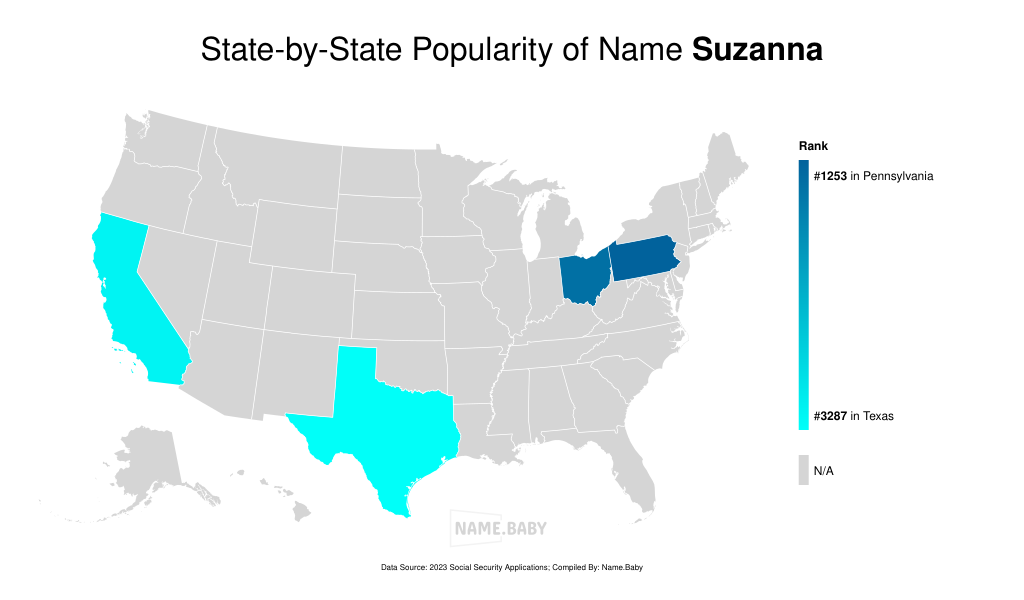
States Popularity Chart
Notable People Named Suzanna
| Suzanna Hamilton is an English actress best known for playing Julia in the 1984 film adaptation of Nineteen Eighty-Four. |
| Suzanna Hext is a British Paralympic swimmer and equestrian who has won European dressage golds and world swimming medals. |
| Suzanna Sherry is an American constitutional law scholar and emerita professor at Vanderbilt University Law School. |
| Suzanna Leigh was a British actress known for her film and television roles in the 1960s and 1970s. |
