Yechezkel
Meaning of Yechezkel
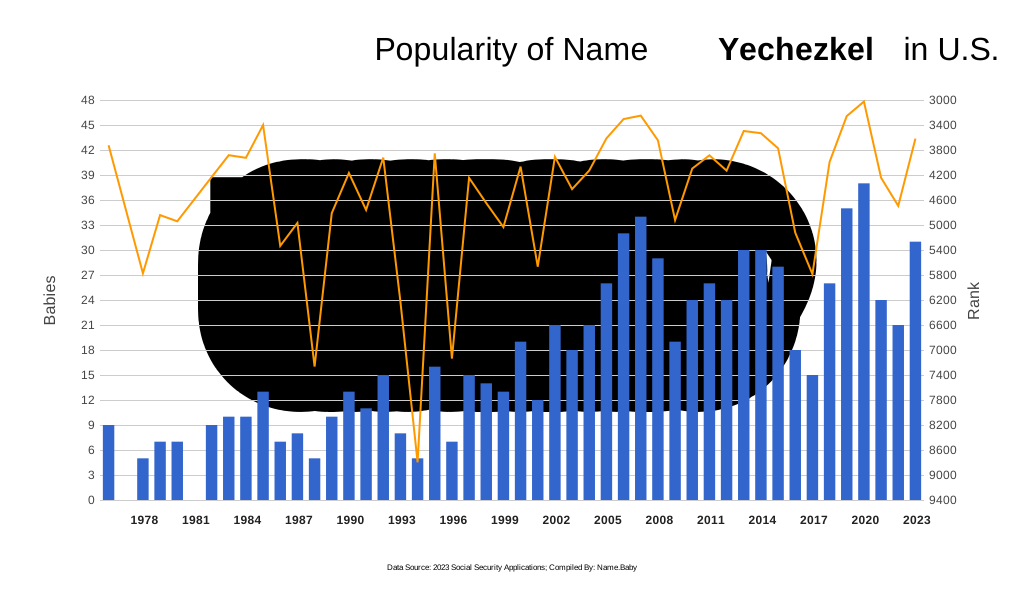
Yechezkel, a masculine name of Hebrew origin derived from Yəḥezqēl—literally “God will strengthen”—is indelibly associated with the sixth-century BCE prophet traditionally credited with authoring the eponymous book of the Hebrew Bible, an affiliation that imparts considerable theological gravitas and historical resonance; its preserved pronunciation in English (yeh-CHEZ-kel, /jɛxɛzˈkɛl/) simultaneously honors its Semitic phonology and conforms to Anglo-American phonetic conventions. A longitudinal analysis of U.S. Social Security data demonstrates that, though the name has never risen to widespread prominence, it has maintained a modest yet consistent presence among newborns since the late 1970s—most recently recording 30 occurrences and a rank of 894 in 2024—thereby reflecting a deliberate preference for names of enduring semantic depth and restrained distinctiveness over more transient naming trends.
Pronunciation
Hebrew
- Pronunced as yeh-CHEZ-kel (/jɛxɛzˈkɛl/)
U.S. Popularity Chart
Notable People Named Yechezkel
| Yechezkel Sarna was a rabbi who helped relocate the Slabodka yeshiva to Hebron and later Jerusalem, becoming its dean in 1934. |
| Yechezkel Landau was an influential Jewish legal scholar best known for his work Noda Biyhudah. |
| Rabbi Yechezkel Levenstein, known as Reb Chatzkel, was a Jewish spiritual leader who guided the Mir Yeshiva through its escape during World War II. |
| Rabbi Yechezkel Shraga Halberstam, known as the Shinever Rov, was a rabbi noted for his disagreements with his father over Jewish law. |
